
Prevent water heater sediment buildup by flushing the tank annually, inspecting and replacing the anode rod before it is fully consumed, keeping the thermostat near 120 degrees, and descaling tankless units yearly. In Wilmington, mineral content in the water supply makes annual service the correct interval, and well-water homes often need it more often.
Why This Matters to Wilmington Homeowners
Most water heaters in this region do not fail because something broke. They fail because minerals accumulated inside for a decade while nobody looked, and the unit slowly lost capacity and structural protection until it either stopped heating properly or corroded through.
That distinction matters because it means most premature water heater failure is preventable. Homeowners tend to treat a water heater as a sealed appliance that either works or does not. It is closer to a piece of mechanical equipment with a consumable protective component and a predictable fouling problem, both of which respond to routine service.
The financial case is unusually clear. An annual service visit costs a small fraction of a replacement installation. Extending a tank from eight years to twelve, or a tankless unit from ten years to eighteen, represents real money. On top of that, a maintained unit runs more efficiently every day it operates, and a maintained unit is far less likely to fail catastrophically onto a finished basement floor.
This guide explains exactly how sediment forms, why it forms faster in some homes in this area than others, and what actually prevents it.
How Sediment Forms Inside a Water Heater
The mechanism is simple chemistry, and understanding it makes the maintenance requirement obvious.
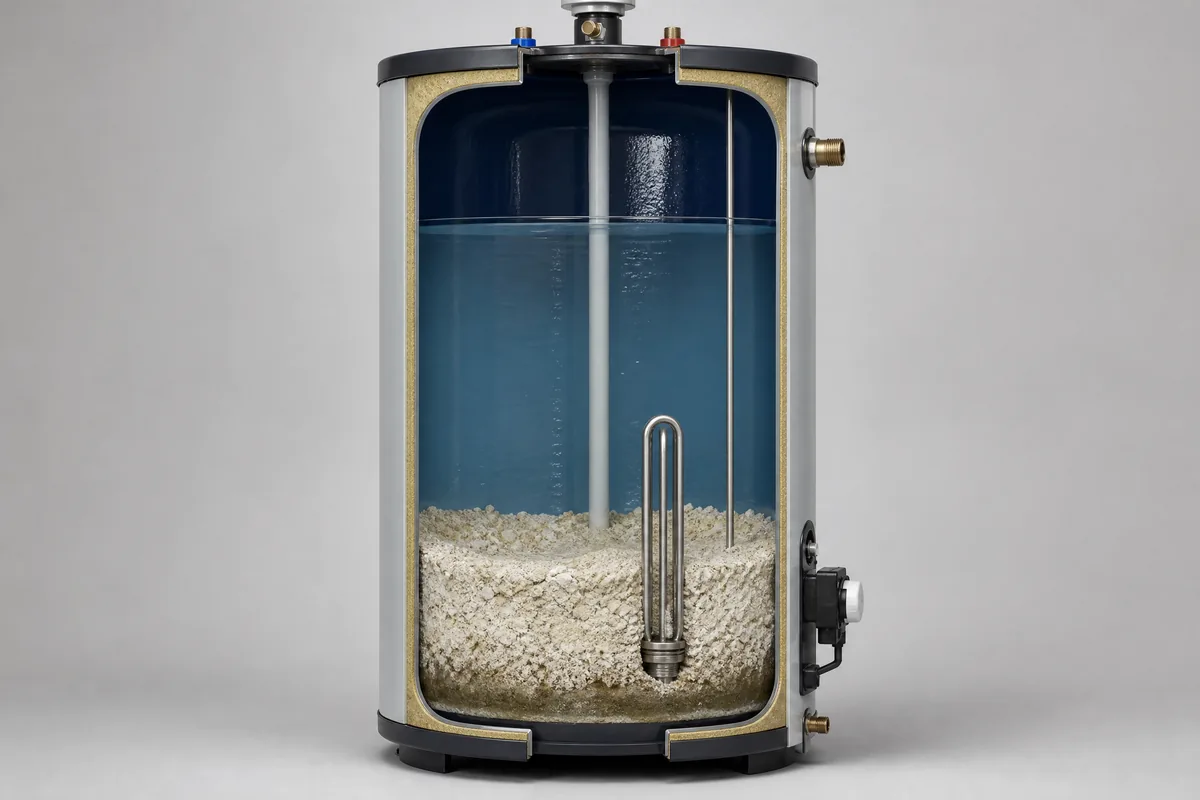
All water carries dissolved minerals, primarily calcium and magnesium compounds. In cold water they remain in solution. When water is heated, solubility drops and those minerals precipitate out as solid particles. Inside a tank water heater, gravity does the rest, and the particles settle to the bottom as a layer of sediment that thickens year over year.
In a gas water heater, this layer sits directly between the burner and the water it is supposed to heat. The consequences are cumulative. The sediment insulates, so the burner must run longer to raise the water temperature, which wastes fuel on every cycle. Water trapped within and beneath the sediment superheats and escapes in bursts, producing the rumbling and popping homeowners hear. The tank bottom experiences elevated thermal stress in exactly the area where corrosion is most likely to begin.
In an electric water heater, the geometry differs but the outcome is similar. Sediment accumulates around the lower heating element, which then operates surrounded by insulating deposits rather than water. That element runs hotter than designed and fails early. This is why premature lower-element failure is one of the most common electric water heater complaints.
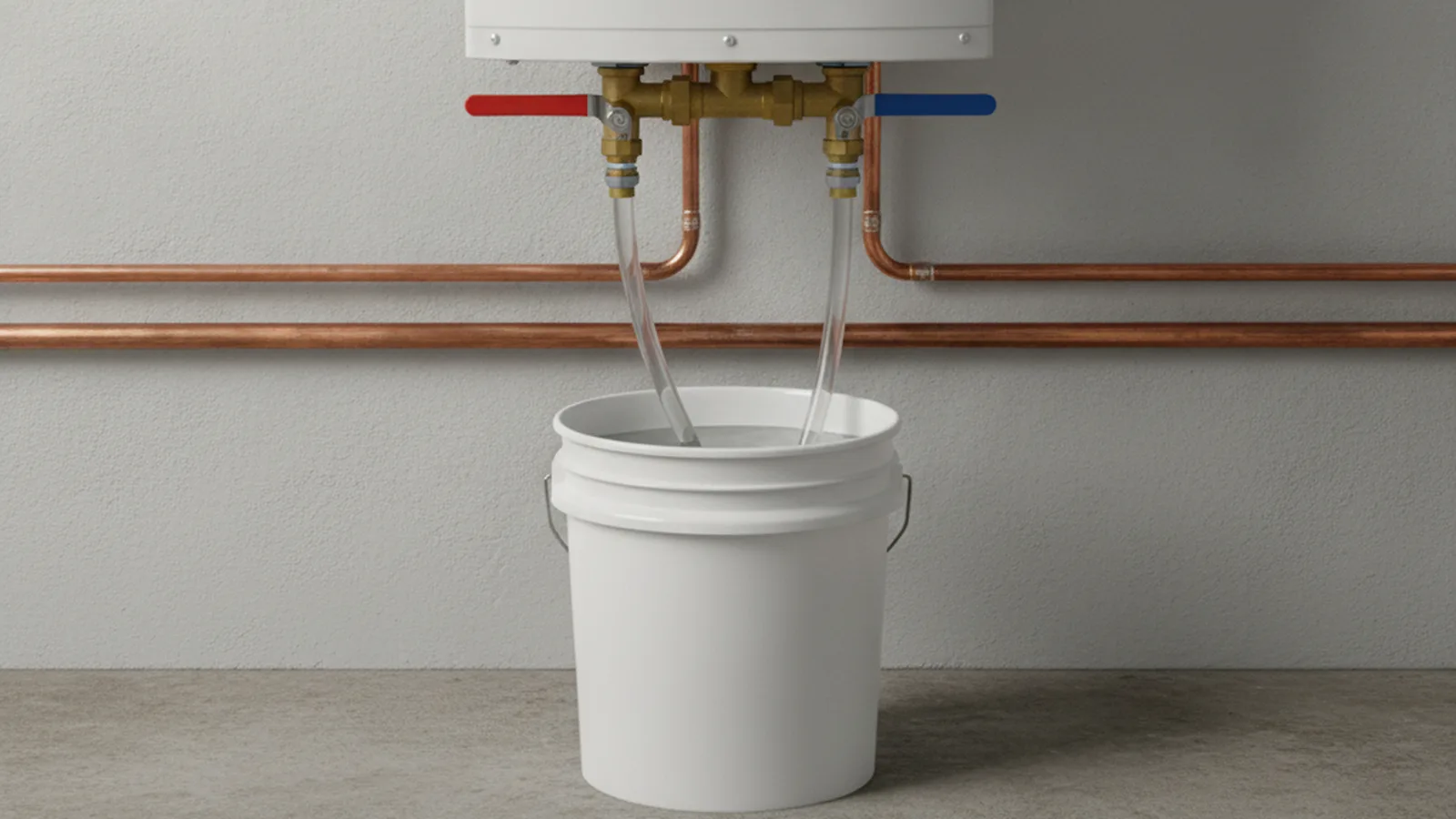
In a tankless unit there is no tank floor for sediment to settle on, but the same chemistry produces scale on the interior surfaces of the heat exchanger. Scale narrows the passages and impedes heat transfer, which reduces output temperature, forces the burner to work harder, and eventually triggers error codes. Because the heat exchanger is the most expensive component in a tankless unit, this is the failure mode that determines whether you get twenty years or ten.
Why Delaware and Tri-State Water Accelerates the Problem
Accumulation rates vary significantly across our service area, and the difference comes down to water source.
Municipal water in Wilmington and Newark carries enough dissolved mineral content that noticeable sediment develops within a few years on an unflushed tank. For most homes on city water in New Castle County, annual flushing is the correct interval, and units that have gone five or more years without service typically have substantial accumulation.
Well water is a different situation. Across Chester County, Pennsylvania and Cecil County, Maryland, a large share of homes draw from private wells, and untreated well water in this region frequently carries considerably higher hardness. Those homes accumulate sediment faster, consume anode rods faster, and scale tankless heat exchangers faster. For hard well water, annual service is the minimum rather than the target, and water treatment upstream of the heater is often the better long-term investment.
There is a secondary local factor near the Chesapeake. Persistent humidity in Cecil County basements and crawlspaces accelerates corrosion on the exterior of the tank, at the fittings, and on the connections. That is a separate mechanism from internal sediment, but it compounds the same outcome, and it is only caught by inspection.
Water temperature setting is the final variable, and it is one homeowners control directly. Higher storage temperatures precipitate minerals faster. A unit running at 140 degrees fouls measurably faster than one running at 120.
What Annual Flushing Actually Accomplishes
Flushing is the core preventive measure for tank water heaters, and it is worth being precise about what it does and does not do.
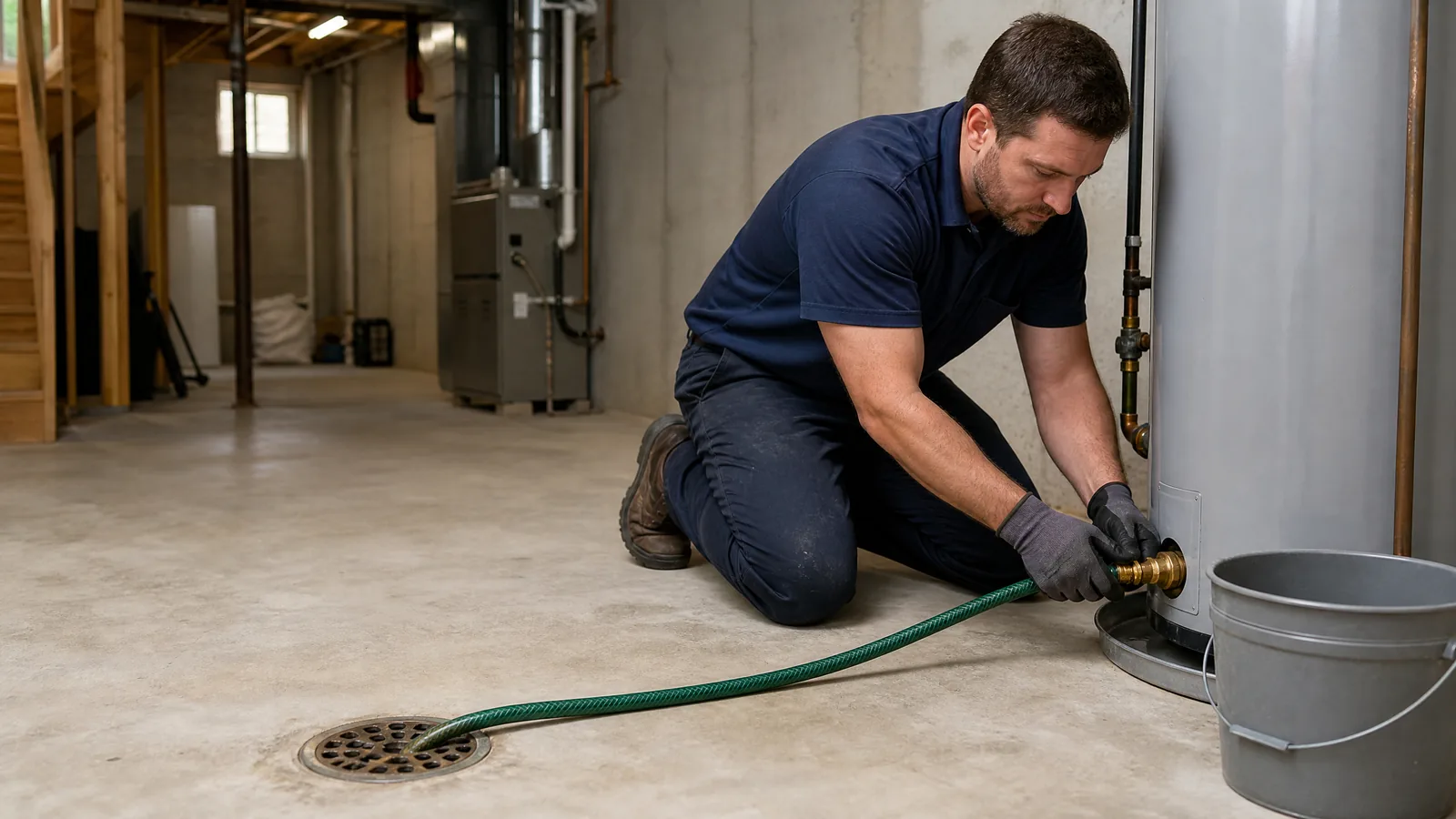
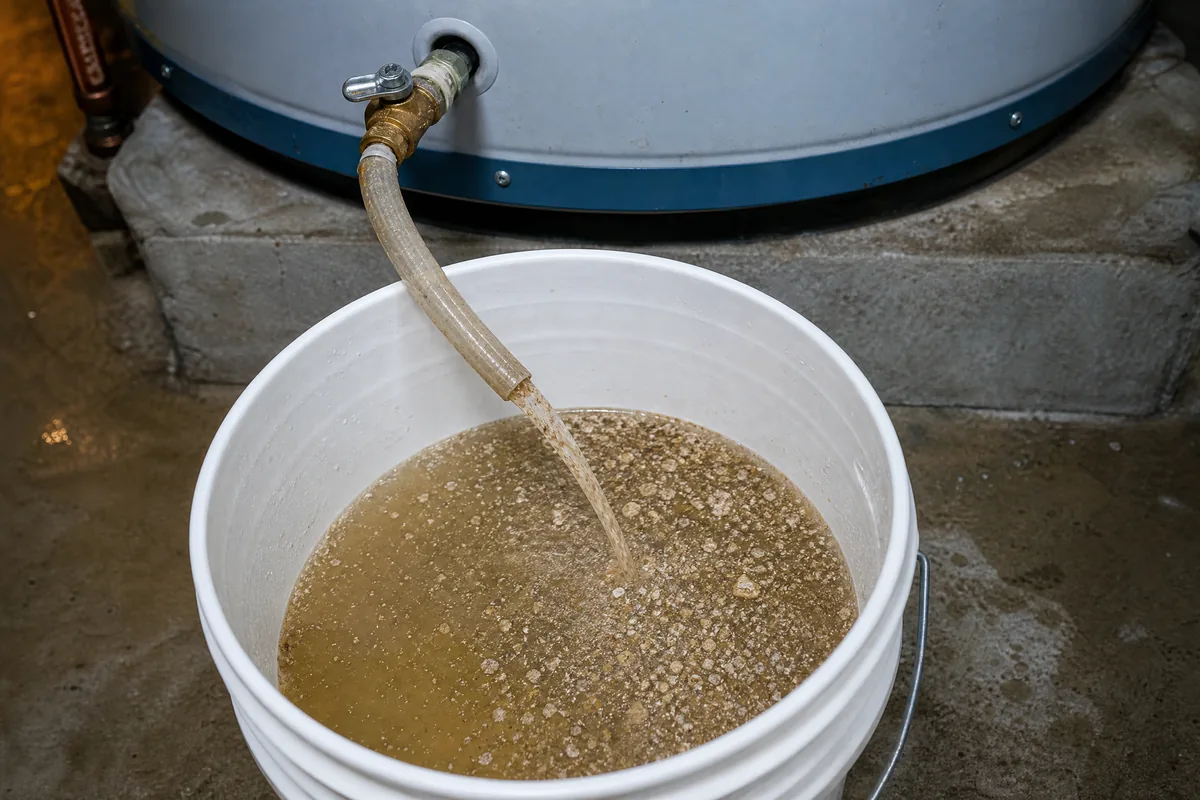
A proper flush removes accumulated sediment from the bottom of the tank. The technician shuts the unit down, connects to the drain valve, and drains the tank, agitating the incoming supply as needed to lift and carry heavier deposits toward the outlet. On a well-maintained unit this is quick. On a unit that has never been serviced, it takes considerably longer because hardened deposits resist movement.
What flushing achieves: restored usable tank volume, improved heat transfer efficiency, reduced thermal stress on the tank bottom, elimination of rumbling, and better recovery rate. On an electric unit it also removes the deposits surrounding the lower element, which extends element life.
What flushing does not achieve: it does not reverse existing corrosion, it does not restore a depleted anode rod, and it does not rescue a tank that has already corroded through. Flushing is preventive maintenance, not repair. A unit at twelve years old with heavy accumulation may already have sustained structural damage that a flush cannot address.
There is a practical warning about doing this yourself. On units that have never been flushed, two problems occur regularly. The drain valve, often plastic on builder-grade units, fails to reseal after being opened and begins leaking. Or hardened sediment blocks the drain outlet entirely, so the tank will not empty and the homeowner is left with an open valve and no flow. Both scenarios require a valve replacement or clearing the blockage without damaging the tank, which is why we carry replacement valves as standard on maintenance visits.
The Anode Rod: The Component That Determines Tank Lifespan
If sediment is the efficiency problem, the anode rod is the lifespan problem, and it receives almost no attention from homeowners.
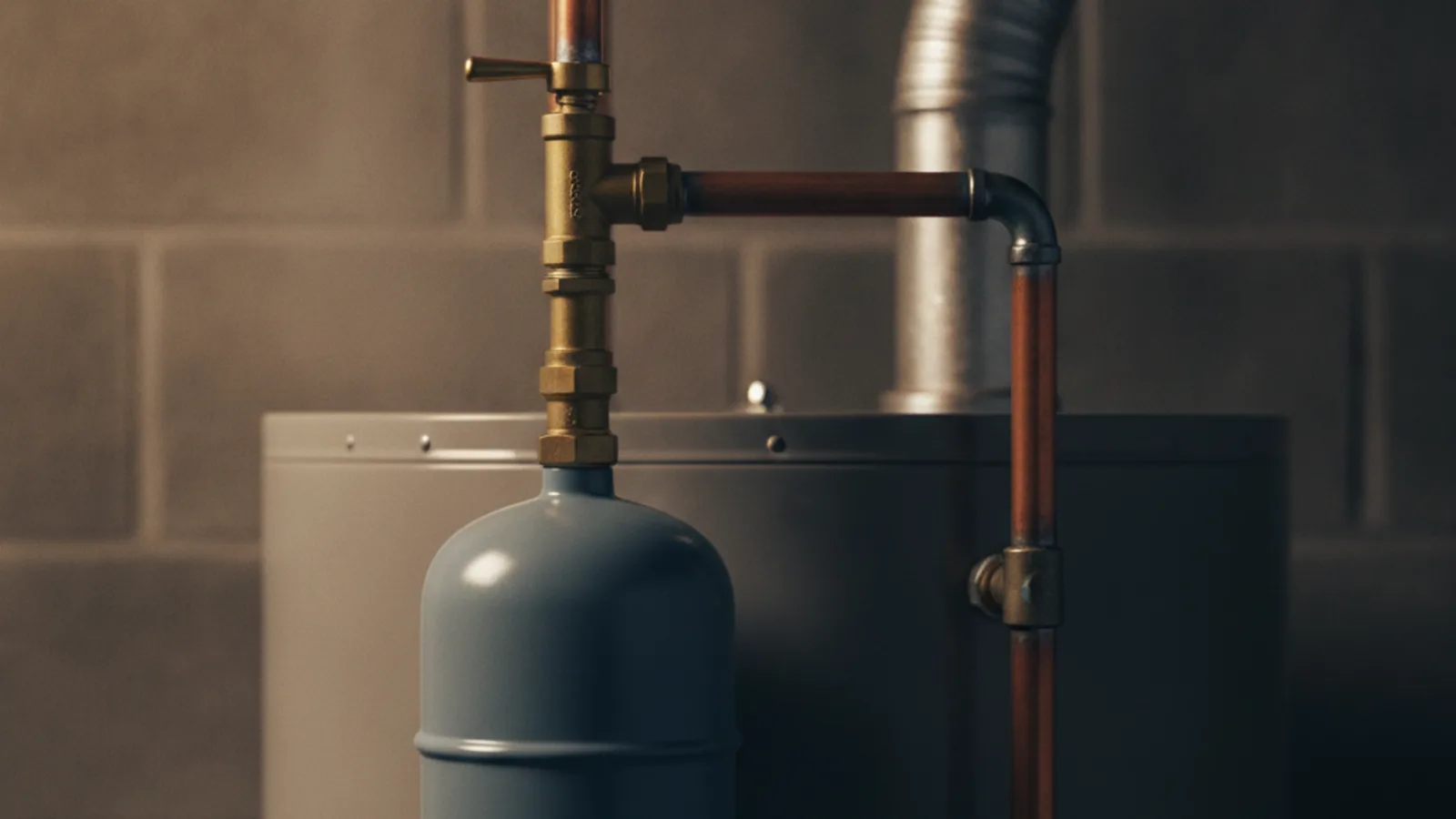
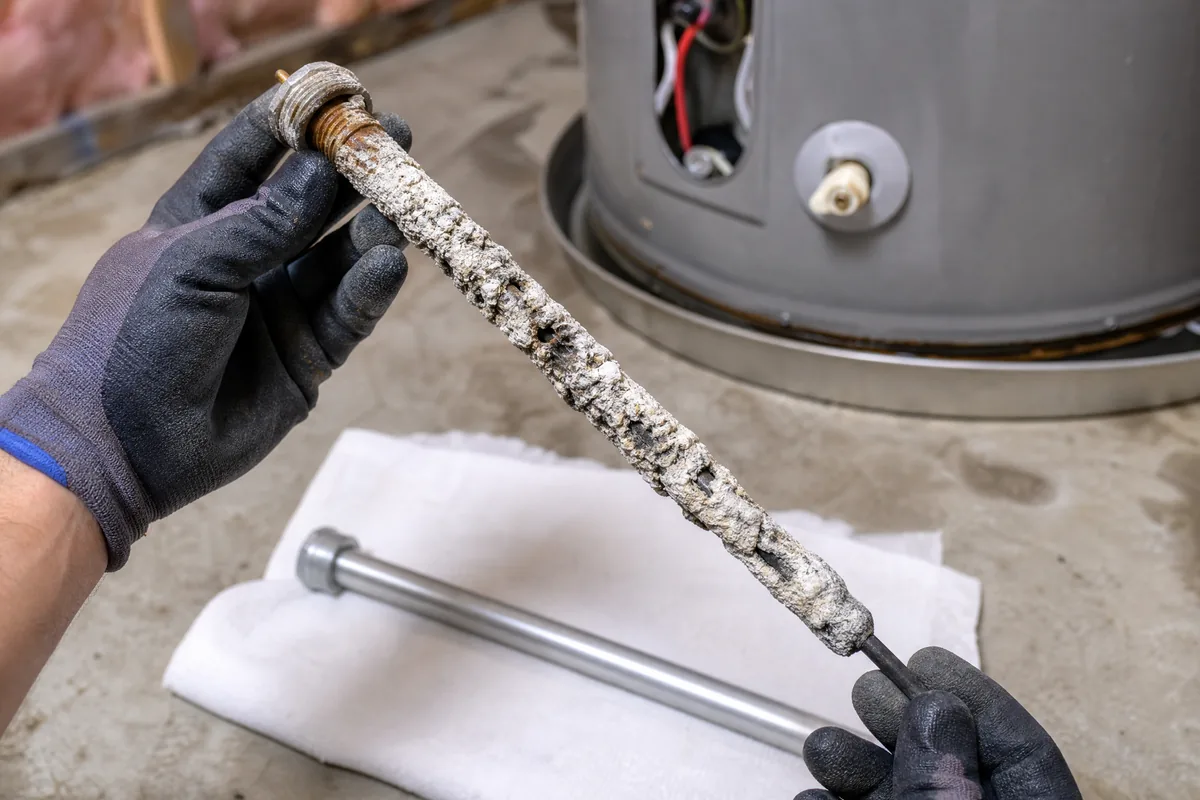
Inside every tank water heater is a rod of magnesium, aluminium, or zinc alloy, threaded into the top of the tank. Its function is electrochemical. Because it is more reactive than the steel tank, corrosion attacks it preferentially. It is designed to be consumed so the tank is not.
It works, and then it is gone. Depending on water chemistry, an anode rod is typically substantially depleted somewhere between three and six years of service, and faster on aggressive well water. Once it is consumed, corrosion has nothing left to attack except the steel tank wall through any faults in the glass lining. That is the point at which the countdown to tank failure begins in earnest.
Replacing an anode rod is inexpensive relative to a tank. Inspecting it during annual maintenance and replacing it when it is significantly consumed is the single highest-value action available for extending water heater life, and it is the step almost universally skipped because nobody looks at a component they cannot see.
There is a diagnostic bonus. A rotten egg or sulphur smell in hot water usually indicates a depleted anode reacting with sulphate-reducing bacteria, which is more common on well systems. Homeowners often assume the water supply has gone bad. Frequently it is an anode replacement, sometimes with a switch to a different alloy.
Need water heater service in Wilmington?
Serving Wilmington with same-day availability and flat-rate pricing confirmed before work begins.
Practical Prevention Steps for Wilmington Homeowners
Here is what actually reduces sediment problems, in order of impact.
Schedule annual professional maintenance. That visit should include a full tank flush, anode rod inspection, temperature and pressure relief valve testing, drain valve inspection, examination of connections and fittings for corrosion, and on gas units verification of burner condition and flue draft. On tankless units it should include descaling the heat exchanger and cleaning the inlet filter screen.
Set the thermostat to approximately 120 degrees. This reduces mineral precipitation, lowers energy consumption, and reduces scalding risk. Going lower is generally not advised because of bacterial growth considerations in stored water.
Address water hardness at the source if you are on a well. In Chester County and Cecil County, softening or treatment upstream of the water heater protects not only the heater but every fixture and appliance in the house. Where hardness is severe, treatment is the more economical decision than repeatedly replacing prematurely failed equipment.
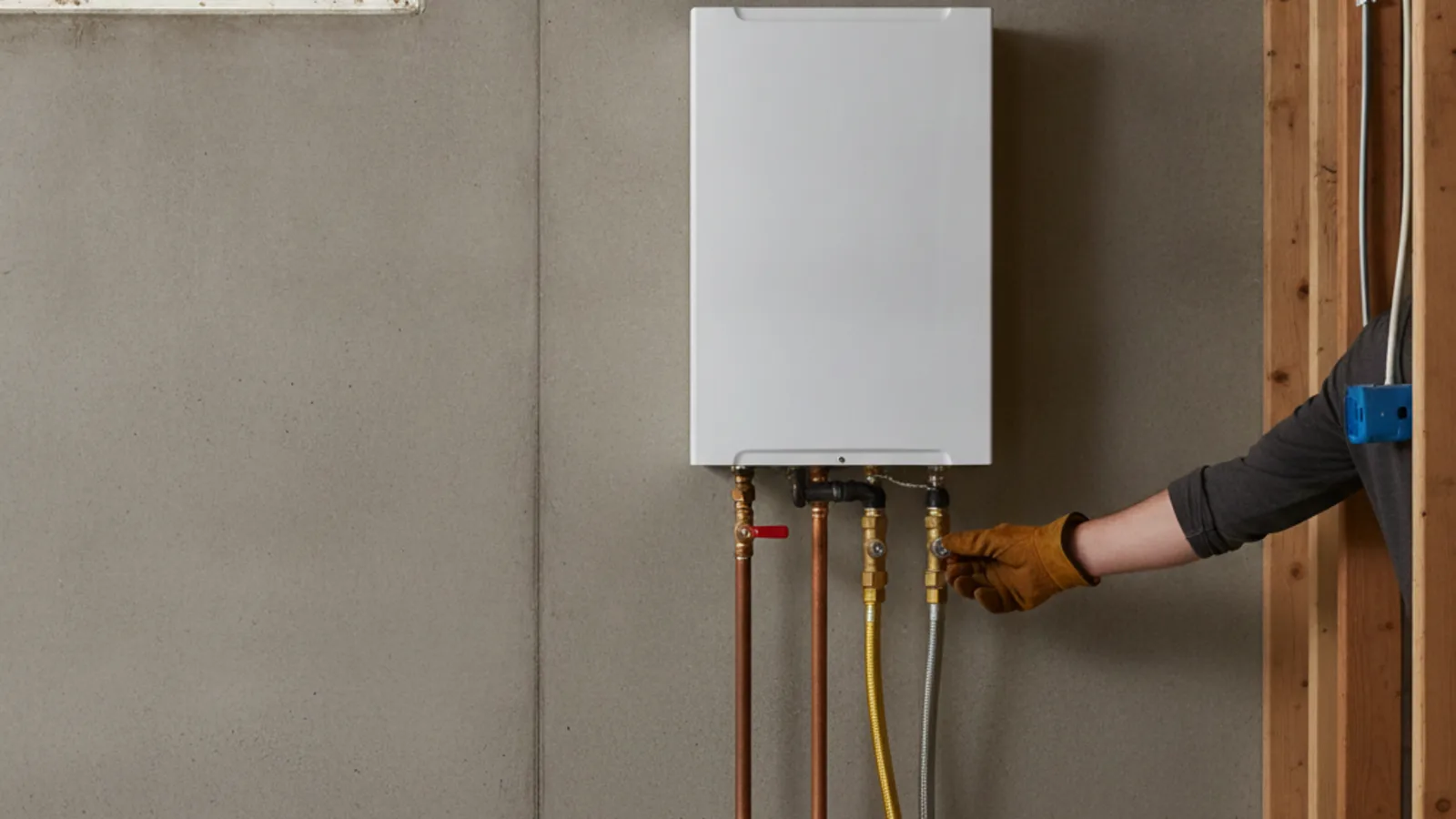
Insist on isolation valves on tankless installations. Without them, descaling requires disassembly, which means it will not get done. Their presence is the difference between a maintainable unit and one that quietly fouls.
Listen to the unit. Rumbling and popping during heating cycles is your notification that sediment has accumulated. Acting on it at year four is maintenance. Ignoring it until year eleven is replacement.
Time maintenance for autumn. Winter inlet water is colder, so the unit runs longer and harder, and equipment already compromised by sediment tends to fail during that period. Servicing beforehand catches weakness while replacement is still a scheduled decision rather than an emergency.
What Maintenance Costs Against What It Saves
Maintenance is the least expensive service performed on a water heater.
Cost depends on whether the unit is tank or tankless, whether descaling is required, and whether components such as a drain valve or anode rod need replacement. Tankless descaling costs more than a tank flush because circulation time and solution are required. Units that have never been serviced take longer than annually maintained ones, which is one reason the cost decreases once the unit is on a regular cycle.
The comparison that matters is against the alternative. An annual visit is a small fraction of a replacement installation. Add the efficiency gain across every heating cycle for a year, and the reduced probability of a catastrophic tank failure over a finished floor, and the return is not a close call.
Be wary of a maintenance offer priced implausibly low. A genuine visit includes inspection, flushing, anode assessment, and valve testing, and it takes time. A five-minute partial drain with no inspection is not maintenance.
When to Call a Professional
Homeowners can reasonably handle thermostat adjustment, visual inspection for moisture and rust staining around the base and fittings, and listening for changes in operating noise.
Call a licensed technician for anything beyond that.
A full tank flush is worth having done professionally on any unit that has not been serviced recently, specifically because of the drain valve and blockage risks described above. Anode rod inspection and replacement requires accessing a threaded fitting that is often seized after years in service, and forcing it improperly damages the tank. Relief valve replacement, element or thermostat work on electric units, and anything involving the gas control valve, burner, or venting all require professional handling for safety reasons. Tankless descaling requires the correct solution, a circulation pump, and correct procedure.
Any moisture at the base of the tank warrants professional assessment, because distinguishing a fitting leak from a tank breach determines whether you have a repair or a replacement.
Need a Plumber in Wilmington? Water Heater Now Is Ready to Help
Sediment is preventable, and preventing it is dramatically cheaper than replacing a water heater that failed early because nobody flushed it. We perform full annual maintenance including flushing, anode inspection, valve testing, and tankless descaling, and we give you an honest read on how much service life your unit has left. Water heaters are the entire business, across Wilmington and the surrounding Delaware, Pennsylvania, and Maryland communities.
To book a service visit, see water heater maintenance in Wilmington. If your unit is already showing symptoms, see same-day water heater repair.
Call us at (302) 240-2818 or contact us today to schedule service in Wilmington and surrounding areas.